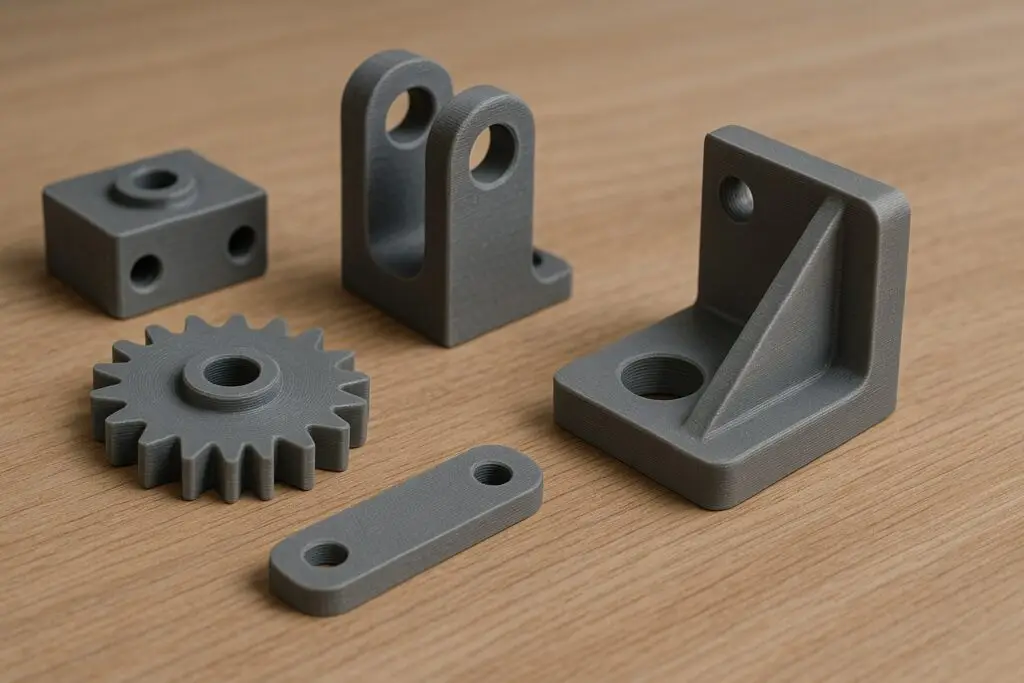
An emblematic material in the early days of FDM 3D printing, ABS has long been the benchmark for the manufacture of technical parts. While PLA and PETG have gained ground thanks to their ease of printing, they do not cover all needs, particularly when a part must withstand impact or be used at low temperatures.
Still widely used in industrial sectors, ABS is still of interest today, provided certain printing and safety constraints are respected.
In this article, we look at the technical characteristics of ABS, its fields of application, good printing practices and the elements to consider for effective use.
What is ABS
ABS, for Acrylonitrile Butadiene Styrene, is a thermoplastic polymer widely used in 3D printing and industry.
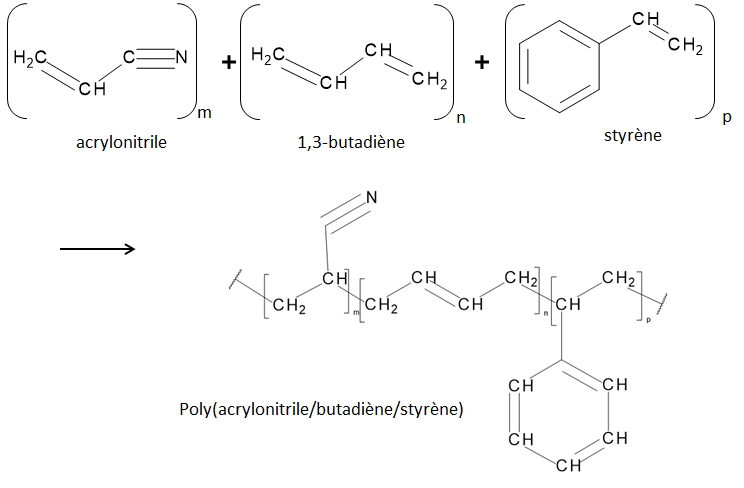
It is a terpolymer, formed by the combination of three monomers: acrylonitrile, butadiene and styrene. This particular structure gives ABS a good balance between rigidity, thermal resistance and excellent impact resistance.
On a microscopic scale, ABS consists of a SAN (styrene-acrylonitrile) matrix in which polybutadiene nodules are dispersed, enhancing the material's ability to absorb energy and limit crack propagation.
Thanks to these properties, ABS filament remains the material of choice for the manufacture of functional parts in 3D printing.
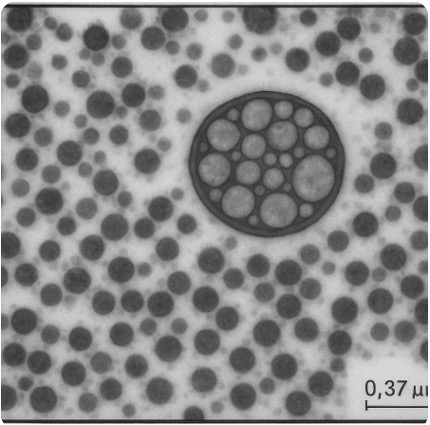
Image generated for educational purposes.
ℹ️ This illustration was inspired by actual electron microscopy (TEM) observations of ABS.
In order to respect copyright and avoid using protected images directly, we have chosen to create our own educational image.
For an actual TEM micrograph showing the structure of ABS, please consult the original article by Bernal et al. (1995) on ResearchGate.
What applications is ABS used for?
ABS is a widely used material in industry, particularly in sectors where impact resistance, light weight and dimensional stability are priorities. It can be found in many everyday products and in specific technical applications.
In industrial manufacturing :
- Automotive components (vehicle interiors, covers, fasteners, ventilation grilles, dashboard trim): its good resistance to low-temperature impact and ease of machining make it a long-standing standard in this field.
- Electronic housings and household appliances (remote control shells, power supplies, coffee makers, vacuum cleaners, hair dryers, printers): ABS is used for its excellent dimensional stability, ease of molding and good thermal resistance.
- Toys, tools, everyday objects (building bricks, children's tools, cases, clip-on parts, storage bins): ABS enables the production of durable, rigid and lightweight parts. In particular, it is the material used for the famous LEGO® bricks.
In 3D printing, ABS filament is suitable for :
- Functional and technical parts subject to shocks or use in slightly harsh environments.
- Prototypes of injection-molded parts, as ABS itself is widely used in injection molding, allowing good continuity between prototype and production.
- Objects requiring post-treatment (sanding, drilling, painting, acetone smoothing), particularly in the design prototyping or modeling sectors.
- Parts that need to be bonded or mechanically assembled, thanks to its good machinability.
The properties of ABS for 3D printing
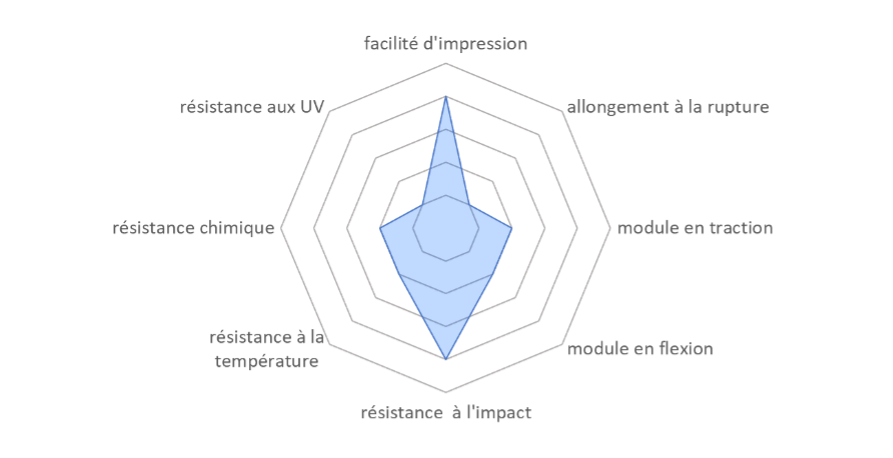
Key properties and performance:
ABS is a material appreciated for its versatility and mechanical behavior. Here are its main characteristics:
- Good rigidity
- Excellent dimensional stability
- Good mechanical resistance, especially to low-temperature impacts
- Scratch resistance
- Light (density ≈1.05 g/cm³)
- Continuous-use temperature resistance up to 80°C
- Easy to machine (drilling, tapping, etc.)
- Easy smoothing and bonding with acetone
- Affordable price
Points to consider:
- Adhesion between layers more difficult than with other materials
- Significant distortion during printing (warping)
- UV-sensitive: tends to yellow outdoors
- Amorphous but opaque material, due to two constituent phases (SAN matrix and butadiene nodules)
- Styrene emissions during printing, classified as a possible carcinogen (IARC group 2B)
How to print ABS?
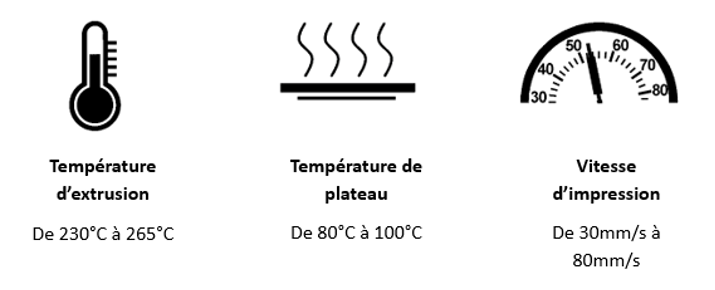
To optimize printing :
- Use a printer with a closed enclosure, to stabilize the ambient temperature around the part and limit warping.
- Protect the tray with a suitable adhesive solution (spray, PEI foil, BuildTak®, etc.) to prevent delamination.
- Reduce ventilation: cooling too quickly encourages shrinkage and cracking.
- Use brims or rafts for complex parts or parts with a large contact surface.
- Reducing printing speed improves inter-layer adhesion.
Solid parts: beware of differential cooling
When printing large parts, the layers at the bottom of the part benefit from the heat of the platen, while the upper layers cool down more quickly. This causes internal stresses and promotes cracking.
A heated or temperature-controlled enclosure limits these temperature variations and improves the cohesion of the layers over their entire height.
What are the risks of 3D printing with ABS?
At room temperature, ABS is considered stable, with no particular toxicity for the user. However, when heated, particularly during printing, it can release styrene, a substance classified as a possible carcinogen by the IARC, and ultrafine particles.
For safe ABS printing :
- Use a closed enclosure
- Efficient filtration(HEPA + activated carbon)
- Always air after printing
- Avoid living areas
- Check condition and maintenance of filtration system
- Limit exposure in shared spaces (classrooms, offices, fablabs...)
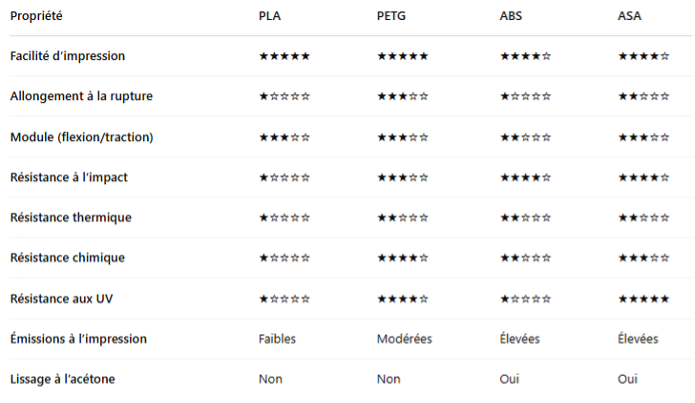
PLA, PETG, ABS, ASA: which filament to choose?
Depending on the application, some polymers are more suitable than others. Here's a quick summary of the main differences between PLA, PETG, ABS and ASA:
Conclusion
ABS remains an attractive technical solution for impact-resistant parts, especially when cold, and is easy to post-process or machine. However, it requires more rigorous printing conditions to guarantee user safety and print quality.
Bibliography
- INRS - French National Institute for Research and Safety
Toxicological data sheet n°105: Acrylonitrile
https://www.inrs.fr/publications/bdd/fichetox/fiche.html?refINRS=FICHETOX_105 - Bernal C., Frontini P., & al.
Microstructure, deformation, and fracture behavior of commercial ABS resins.
Polymer Engineering & Science, 1995.
https://www.researchgate.net/publication/229904621_Microstructure_deformation_and_fracture_behavior_of_commercial_ABS_resins - Seelig T., Van der Giessen E.
Effects of microstructure on crack tip fields and fracture toughness in PC/ABS polymer blends.
https://www.researchgate.net/publication/30494524_Effects_of_microstructure_on_crack_tip_fields_and_fracture_toughness_in_PCABS_polymer_blends - MDPI Polymers
Review article on ABS plastics.
https://www.mdpi.com/2073-4360/14/10/2105 - Alveo3D - Filtration solutions for 3D printing
https://www.alveo3d.com/en/shop/ - Omnexus - SpecialChem
Selection Guide: Acrylonitrile Butadiene Styrene (ABS) Plastic - Key Applications
https://omnexus.specialchem.com/selection-guide/acrylonitrile-butadiene-styrene-abs-plastic/key-applications - Francofil
Additive Manufacturing: Polymers used in FDM (Fused Deposion Modeling)
In-house training carried out in 2022 at NextMove's request.